
When Tate Modern contacted Anglia Decor about the Turbine Hall, the brief was unusual. The artist Tania Bruguera was installing a major commission in response to the global migration crisis. The artwork required a heat-sensitive floor that would reveal a hidden photographic portrait when enough visitors stood together and applied body heat to the surface. Our job was to apply a protective resin layer over the completed artwork, without breaking the thermochromic effect and without failing under an estimated 5.9 million annual visitors.
The artwork beneath the coating
The Tate's installation team built the artwork up in layers. The original Turbine Hall floor was first protected with plastic floor tiles. A primer coat and 2 coats of black paint formed the base layer. The portrait itself was spray-applied in heat-reactive thermochromic paint and depicts the face of Yousef, a young man who left Syria in 2011 and now studies biomedical science and works for the NHS.
His image stays hidden under the black surface until enough body heat from grouped visitors causes the thermochromic layer to become transparent and gradually reveal the portrait beneath. Any coating applied on top had to be thin enough and conductive enough to let that effect work.
Why we specified Polyaspartic
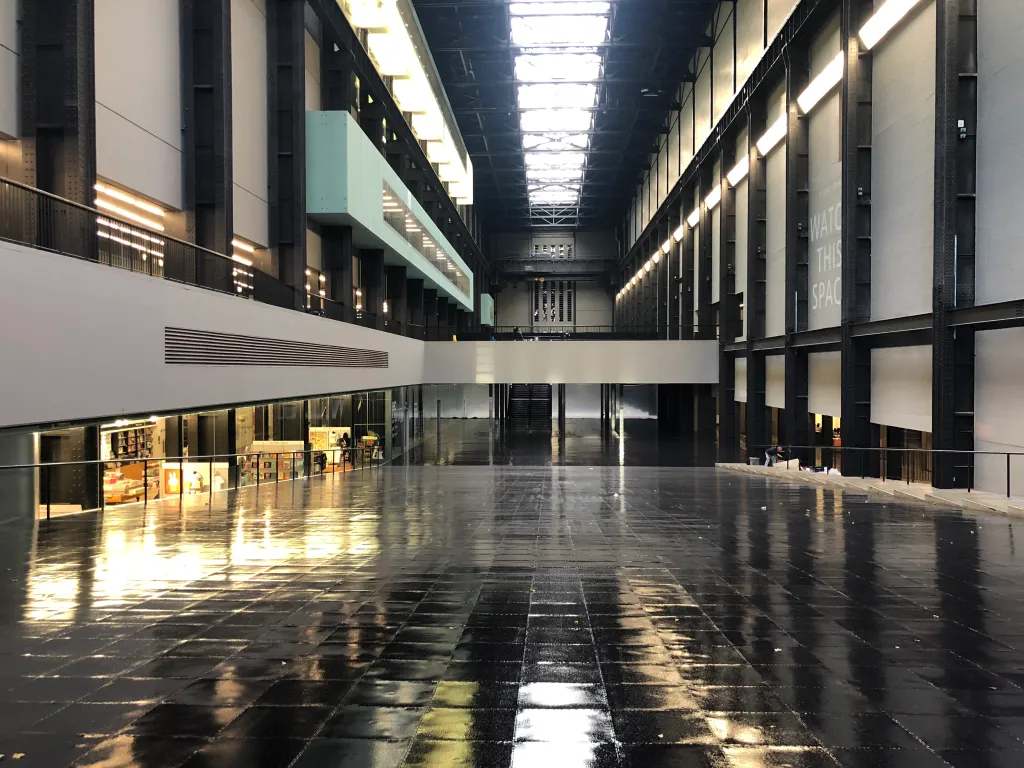
We applied an anti-slip Polyaspartic epoxy floor coating across the full 3,200m² ground floor area of the Turbine Hall, with a separate matt protective coating to a 400m² section. Polyaspartic was the right system for 3 reasons specific to this venue:
- Rapid cure. Polyaspartic systems set in hours rather than days, which is essential when you are working around an in-house art install team and other contractors building out the wider commission.
- Abrasion resistance. The Turbine Hall is one of the most-visited cultural spaces in the world. The coating had to handle hundreds of thousands of footfalls without wearing through to the artwork beneath.
- Thin-film application. Polyaspartic films can be laid down very thin while still being mechanically robust, which protects the thermochromic effect.
Working in the Turbine Hall
Anglia Decor completed the coating on schedule, working around Tate's installation team and the other contractors involved in the wider build. The protective coating performed exactly as required, safeguarding the original Turbine Hall floor and the artwork itself while providing a durable anti-slip surface for the duration of the installation.
Heritage venues, artworks, and high-footfall public buildings demand a different coating approach to a standard warehouse floor. The chemistry has to be matched to the specific brief, not pulled off a price list. Read the full Tate Modern Turbine Hall case study or talk to our resin flooring team about complex protective coating projects.