
Geeplus is a specialist manufacturer of electromagnetic actuators, solenoids, and voice coil motors based at the Triple Two Centre in Beckenham, Kent. They contacted Anglia Decor after a recently applied solvent-based floor paint had failed within weeks of being put down.
The previous contractor had used an STR machine to prepare the concrete and then rolled a solvent-based floor paint straight over the top. The problem: roughly 1mm of carpet adhesive was still bonded to the slab from a previous floor covering. The new paint had nothing solid to grip to, and the result was widespread coating failure across the entire floor area. New floors like this are far easier to get right on a factory and unit build from the start.
Why the original system failed
Solvent-based floor paints rely on an absolutely clean, properly profiled substrate. They have no aggressive mechanical or chemical anchor to compensate for a weak layer underneath. When they are applied over residual adhesive, the entire coating is only as strong as the bond between the adhesive and the concrete, and old adhesive is not a structural material.
The STR machine the previous contractor used is a light-duty preparation tool. It is fine for taking the surface tension off bare concrete. It will not strip 1mm of carpet adhesive. The job needed heavier equipment from the outset.
How Anglia Decor approached the recovery
We started with a 3-phase ride-on floor grinder fitted with PCD (polycrystalline diamond) shoes. PCD tooling is specifically designed for removing stubborn coatings, adhesives, and surface contaminants that conventional grinding cannot handle. We used it to mechanically strip the full 1mm layer of carpet adhesive back to clean concrete.
Once the adhesive was off, we switched to standard diamond grinding heads to refine the slab. PCD shoes are aggressive and leave score marks behind them, the second pass removes those marks and leaves a smooth, properly profiled surface with a strong mechanical key. Bolt holes, minor cracks, and surface scratches were then filled and levelled to give a flat, even base.
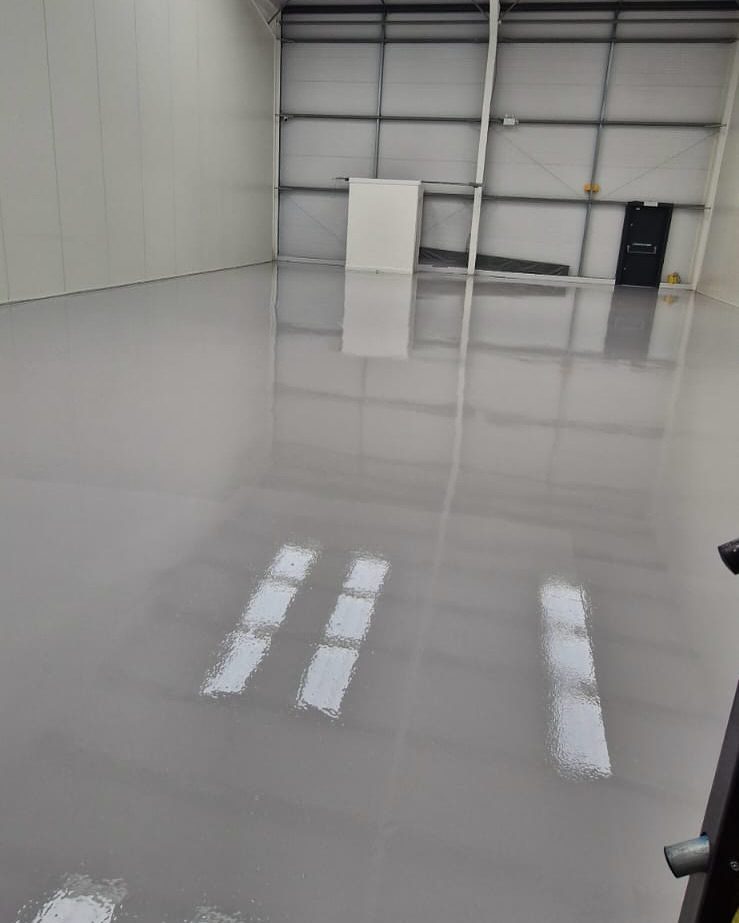
The replacement coating system
We applied 2 coats of high-build solvent-free resin in Goosewing Grey, building up a dry film thickness of 400 microns. Solvent-free resin systems offer 3 advantages over the solvent-based paint that had failed:
- Superior adhesion. Solvent-free resins bond mechanically and chemically to properly prepared concrete, eliminating the adhesion failures of the previous coating.
- Chemical resistance. The cured film resists the oils, solvents, and cleaning chemicals common in light industrial environments.
- Durability. A 400-micron DFT gives a 5–6 year lifespan under light industrial traffic, compared to a few weeks of failure on the original system.
The lesson for any failed floor
If you have just paid for a floor coating that is already lifting, the temptation is to call the same trade back for another coat. Don't. The new coating will fail in the same plane as the old one because the underlying problem, a weak bond layer, is still there. The only proper fix is mechanical removal back to a sound substrate using equipment matched to the contaminant being removed.
Geeplus now have a properly prepared, professionally coated factory floor backed by our standard 12-month no-quibble warranty. Read the full Geeplus Beckenham case study or get in touch with our resin flooring team if you have a coating that has failed prematurely.