
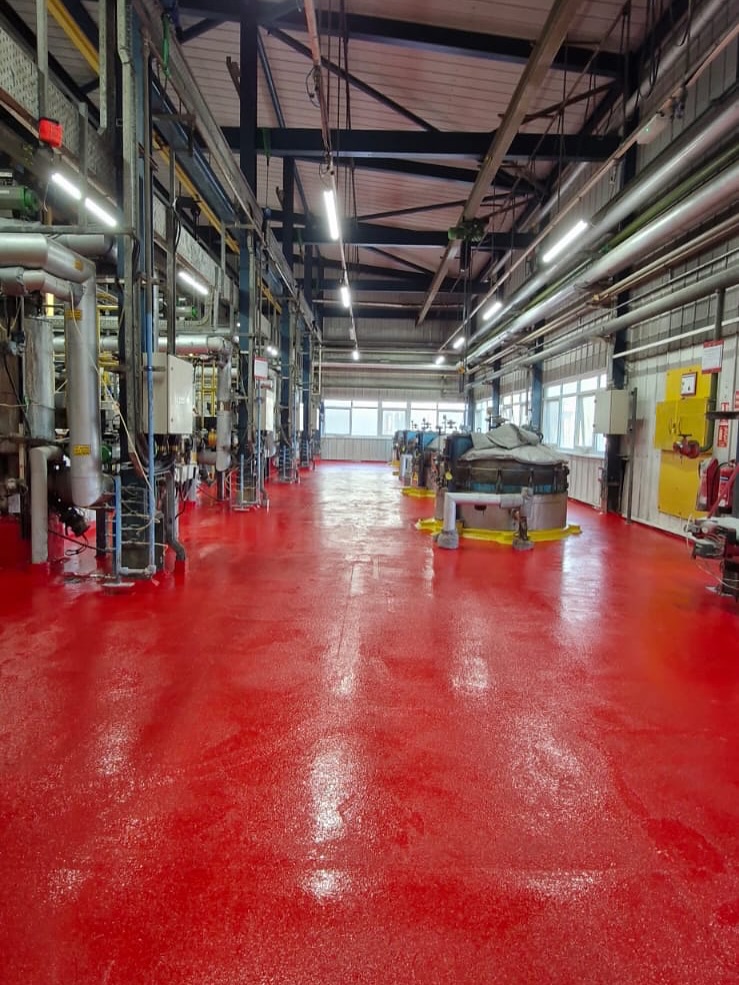
Epoxy flooring is a two-part polyurethane coating system that bonds chemically to concrete substrates, creating a seamless, high-performance surface. But it's not suitable for every application – understanding the advantages and disadvantages will help you choose whether it's right for your facility.
What are the main advantages of epoxy flooring?
Epoxy flooring offers seven key benefits for industrial, commercial, and workshop environments.
1. Superior stain and chemical resistance
The resin layer repels oils, solvents, petrol, and corrosive substances without absorption. This makes epoxy essential for garages, automotive workshops, and food production facilities where spills are routine.
An epoxy surface for food production areas withstands both cleaning compounds and acidic residues. Unlike concrete, which is porous and absorbs contaminants, epoxy creates an impermeable barrier.
2. Seamless, non-porous finish
Poured as a continuous surface, epoxy eliminates grout lines and crevices where bacteria accumulate. This is critical in pharmaceutical manufacturing, medical facilities, and food processing where hygiene standards demand impeccable surfaces.
The absence of joints means water, dust, and pathogens cannot penetrate seams – something traditional tiled or grouted floors cannot guarantee.
3. Durability under heavy traffic
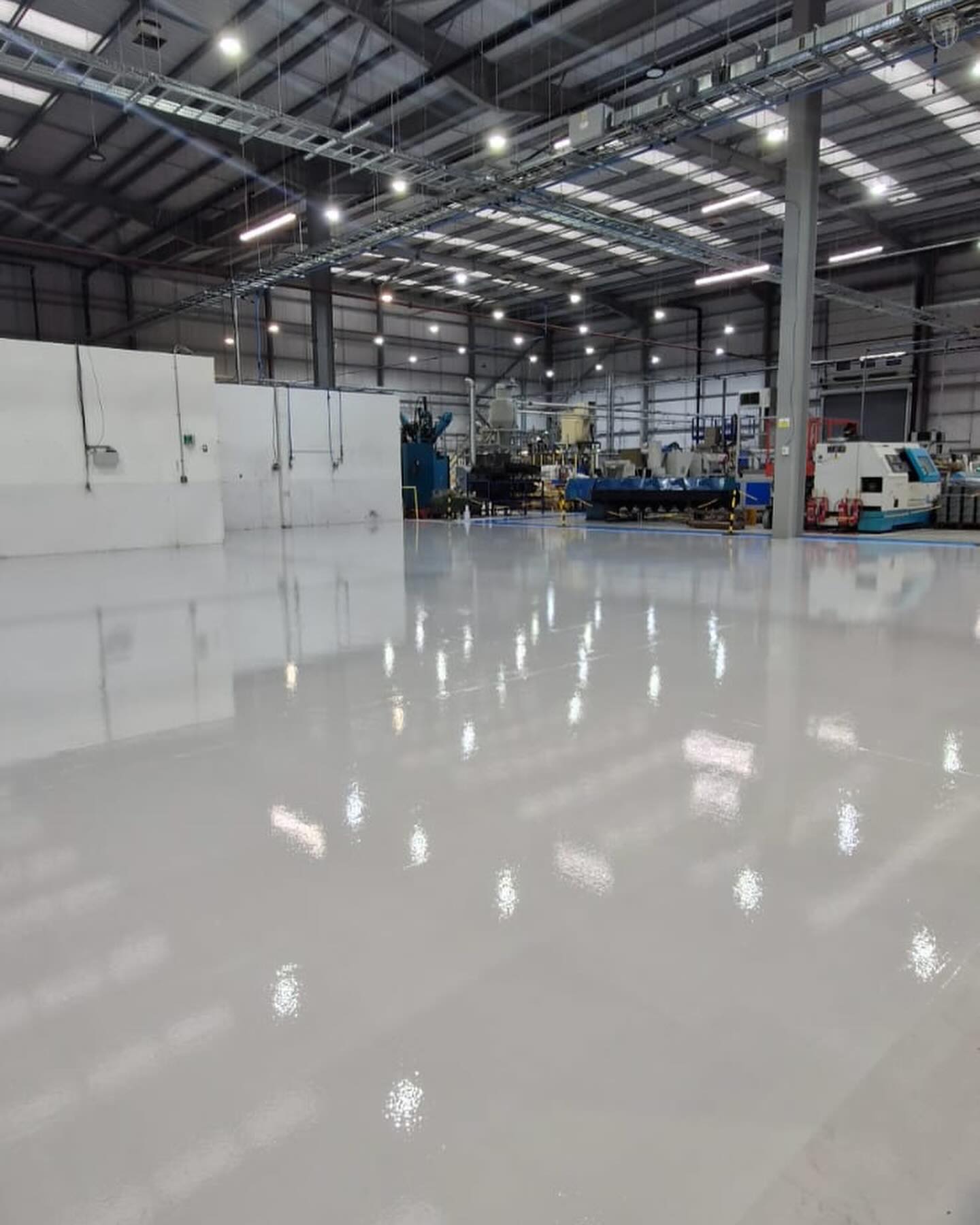
A properly cured epoxy coating (4–7mm thickness) withstands forklift traffic, rolling equipment, and constant foot movement without delamination or joint cracking. Industrial facilities report 15–25 years of service life with minimal deterioration.
Warehouse flooring demands this resilience. Warehouse epoxy flooring specifications often require 80+ Durometer hardness and flexural strength exceeding 10 MPa. On warehouse construction projects, we lay the floor as the final stage of the build.
4. Fast, straightforward maintenance
A daily sweep followed by damp mopping removes dirt and spills. No grout sealing, no trapped moisture, no porous substrate retention of odours. This reduces labour costs and facility downtime.
Chemical-resistant epoxy requires only neutral pH detergents – acidic or abrasive cleaners damage the finish.
5. Design flexibility and aesthetic control
Epoxy accepts solid colours, metallic pigments, coloured quartz aggregates, and glass flake inclusions. Some systems incorporate safety-marked zones using contrasting colours, functional for both aesthetics and wayfinding.
6. Slip-resistance and safety formulations
Anti-slip additives (aluminium oxide or silica grit) reduce slipping hazard ratings from R10 to R11–R13. Fire-rated formulations meet UK Building Regulations for escape routes.
7. Long-term cost efficiency
Initial installation cost ($15–$30/m² depending on system type and substrate prep) recovers within 8–12 years through reduced replacement cycles and maintenance labour. Concrete, by contrast, requires resurfacing every 10–15 years.
What are the main disadvantages of epoxy flooring?
1. Professional installation is mandatory
Epoxy cannot be applied successfully without proper surface preparation. Concrete must be profiled to 250–350 microns (often via mechanical grinding), tested for moisture (calcium chloride <3% or relative humidity <75%), and cleaned to remove oil, dust, and laitance.
A two-part system requires precise mixing ratios and controlled cure temperatures (typically 15–25°C). Any deviation results in soft, sticky, or unevenly cured patches.
The pot life (30–90 minutes depending on formulation) means a large space must be applied continuously – stopping mid-application creates permanent seams.
2. Extremely difficult to remove
Once cured, epoxy bonds so thoroughly to concrete that removal requires grinding, shot blasting, or chemical stripping – methods that are expensive, time-consuming, and often damage the substrate beneath. Budget £30–£50/m² if removal becomes necessary.
3. Requires strict, ongoing maintenance discipline
Spills, dust, and abrasive grit must be cleaned immediately. Neglect allows dirt particles to embed in the surface, accelerating wear and causing dull patches. Acidic substances (vinegar, citrus cleaners, battery acid) will soften or etch the finish if left standing.
Unlike concrete, which tolerates neglect, epoxy demands consistency.
4. Moisture sensitivity during installation
Concrete moisture causes blistering and delamination. Testing before application is essential – if moisture levels exceed 3% (calcium chloride test) or 75% relative humidity, the epoxy will not cure properly.
5. Limited temperature tolerance
Standard epoxy softens at 60°C and begins failing at 80°C. Industrial spaces with high ambient heat or direct sunlight in summer may require polyaspartic or polyurea alternatives, which cost 20–30% more.
Choosing the right epoxy formulation
What's the difference between high-solids and low-solids epoxy?
High-solids epoxy (solid content 82–100%) requires only one application to achieve 2–3mm thickness, reducing labour and curing time. It generates lower volatile organic compound (VOC) emissions, meets stricter environmental regulations, and typically outlasts low-solids systems by 5–10 years.
Low-solids epoxy (50–70% solids) needs multiple coats to build adequate thickness. This extends installation time, increases labour, and produces higher VOC levels – problematic for indoor spaces or sensitive environments.
High-solids systems cost 15–25% more upfront but deliver superior durability and lower VOC profiles.
What about low-VOC formulations?
Low-VOC epoxy systems (<100 g/L) are essential in food production areas, pharmaceutical facilities, and occupied commercial spaces where air quality matters. They cure faster, produce minimal odour, and present no respiratory hazards to nearby staff.
Standard epoxy (<400 g/L) requires site evacuation and continuous ventilation during application – a constraint that low-VOC eliminates.
Colour, finish, and safety considerations
Beyond solid colours, epoxy flooring systems offer metallic finishes for aesthetics, anti-slip textures for safety, and UV-stable pigments for outdoor-facing areas. Safety-marked zones (yellow/black stripes for equipment routes, red for hazard areas) can be incorporated during installation.
For chemical-resistant environments requiring enhanced durability, chemical-resistant flooring solutions combine epoxy resin bases with reinforced polymeric layers that exceed standard epoxy performance against aggressive substances.
When should you choose epoxy over alternatives?
Epoxy is the right choice when your facility demands:
- Chemical, oil, and solvent resistance (garages, workshops, laboratories)
- Hygiene and food safety compliance (food processing, kitchens, pharmaceutical manufacturing)
- Heavy traffic and forklift use without joint cracking
- Low-maintenance, fast-cleaning surfaces
- Custom aesthetics or safety marking
It's not suitable for spaces with:
- High moisture content or standing water (epoxy will blister)
- Ambient temperatures above 60°C (alternative polyurethanes required)
- Frequent aggressive chemical stripping or degreasing
- Inability to maintain cleaning discipline
The installation and ongoing cost equation
Installation costs typically range £20–£40/m² for a single epoxy coat, depending on substrate condition and system type. Surface grinding and moisture testing add £3–£8/m².
Maintenance costs are minimal – neutral-pH cleaner and labour for weekly mopping. Over 20 years, this is substantially lower than resealing concrete every 10–15 years.
Replacement cycle for epoxy is 15–25 years in moderate-traffic spaces, longer in light-traffic areas. Concrete requires resurfacing within 10–15 years, making epoxy the more economical choice over a facility's lifetime.
Getting professional epoxy installation right
Specification, surface preparation, mixing protocols, and cure conditions determine whether epoxy delivers 20+ years of performance or fails within 5 years. Working with an experienced contractor – one who tests moisture, profiles the substrate to specification, and provides cure-period documentation – is non-negotiable.
At Anglia Decor, we handle every stage: moisture and adhesion testing, substrate grinding, two-part resin mixing under controlled conditions, and full cure documentation. Contact our industrial flooring team to discuss whether epoxy is the right system for your facility and to arrange a site survey. We also lay floors on new commercial buildings as part of the fit-out.